The Divine Conspiracy
Dallas Willard
Beware of this Life Changing Book!
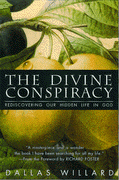 Dallas Willard's staple piece on Christian discipleship, The Divine Conspiracy: Rediscovering Our Hidden Life in God , is a challenging book for those who want more out of their ‘Christian life' than the typical mediocrity that has cursed the western Church in the twenty-first century.
To be up front and honest, my intentions to review this book are purely selfish. As a missionary, my desire first of all is to see many people come to Christ. The second is to see those who profess Christ to be their Lord to ‘get real' with Him, and to truly live their lives as though He was their Lord. This book is all about living our Christian lives (or ‘kingdom living' as Willard calls it) to the fullest as we learn the Kingdom principles as taught by Christ.
Willard utilizes his knowledge of historical, biblical background to interpret and apply the great discourse of Christ on the mount, shedding valuable light on God's Kingdom and its influence on our lives today. As Christians we are called to more than just Sunday morning church services, but to be active participants in God's Kingdom. Willard is quick to point out that Christian's are entitled to more than just fire insurance or worse yet to be ‘consumers', but are called to be disciples, and to take part of the privilege and honour of living the Kingdom life now.
While this book is written by an academic professor of philosophy and theology, and thus can have deep and even intimidating content and language structure, it is a masterpiece of great value for those who desire to have more in their lives and who are willing to tackle the subject of Christian discipleship at great depth. -- Scott Key, GSM contributor.
From the Back Cover
"I am struck by many things in The Divine Conspiracy...
First, I am struck by the comprehensive nature of this book...It provides me with a conceptual philosophy for understanding the meaning and purpose of human existence...The breadth of the issues covered is astonishing: from the soul's redemption and justification to discipleship and our growth in grace to death and the state of our existence in heaven...
Second, I am struck by the accessibility of this book. I'm fully aware that the issues discussed here are of immense importance, yet it is all so understandable, so readable, so applicable...
Third, I am struck by the depth of this book. Willard is a master at capturing the central insight of Jesus' teachings. Perhaps this is because he takes Jesus seriously as an intelligent, fully competent Teacher. He writes, 'Jesus is not just bright, he is brilliant.'...
My fourth and final observation...I am struck by the warmth of this book. Rarely have I found an author with so penetrating an intellect combined with so generous a spirit. Clearly he has descended with the mind into the heart and from this place he touches us, both mind and heart."--From the foreword by Richard J. Foster, author of Celebration of DisciplineAbout the Author
Theologian and scholar Dallas Willardhas long been an eloquent voice for the relevance of God in our daily lives. His groundbreaking books In Search of Guidance and The Spirit of the Disciplines forever changed the way thousands of Christians experience their faith. He is a professor at the University of Southern California 's School of Philosophy and has held visiting appointments at UCLA and the University of Colorado . He lives in southern California .
Excerpted from The Divine Conspiracy : Rediscovering Our Hidden Life in God by Dallas Willard, Richard J. Foster. Copyright © 1998. Reprinted by permission. All rights reserved
Entering the Eternal Kind
Of Life Now
God's care for humanity was so great that he sent his unique Son among us, so that those who count on him might not lead a futile and failing existence, but have the undying life of God Himself.
JOHN 3:16
Jesus' good news, then, was that the Kingdom of God had come, and that he, Jesus, was its herald and expounder to men. More than that, in some special, mysterious way, he was the Kingdom.
MALCOLM MUGGERIDGE,
JESUS: THE MAN WHO LIVES
Life in the Dark
Recently a pilot was practicing high--speed maneuvers in a jet fighter. She turned the controls for what she thought was a steep ascent--and flew straight into the ground. She was unaware that she had been flying upside down.
This is a parable of human existence in our times--not exactly that everyone is crashing, though there is enough of that--but most of us as individuals, and world society as a whole, live at high-speed, and often with no clue to whether we are flying upside down or right-side up. Indeed, we are haunted by a strong suspicion that there may be no difference--or at least that it is unknown or irrelevant.
Rumors from the Intellectual Heights
That suspicion now has the force of unspoken dogma in the highest centers of Western learning. Of course, one has to assume in practice that there is a right-side up, just to get on with life. But it is equally assumed that right-side up is not a subject of knowledge.
Derek Bok was president of Harvard University for many years, and in his "President's Report" for 1986-1987 he referred to some well-known moral failures in financial circles and the political life of the nation. He wondered out loud what universities might do to strengthen moral character in their graduates.
"Religious institutions," he continued, "no longer seem as able as they once were to impart basic values to the young. In these circumstances, universities, including Harvard, need to think hard about what they can do in the face of what many perceive as a widespread decline in ethical standards."'
Bok points out that in other days "the instructors aim was . . . to foster a belief in commonly accepted moral values" (p. 10). Now all is changed: "Today's course in applied ethics does not seek to convey a set of moral truths but tries to encourage the student to think carefully about complex moral issues." One senses that the governing assumption of his discussion is that these two objectives are mutually exclusive.
"The principle aim of the course," Bok continues, "is not to impart 'right answers' but to make the students more perceptive in detecting ethical problems when they arise, better acquainted with the best moral thought that has accumulated through the ages, and more equipped to reason about the ethical issues they will face" (p. 10).
Later he quotes Carol Gilligan to the effect that "moral development in the college years thus centers on the shift from moral ideology to ethical responsibility" (p. 30). One should not miss the point that Bok puts "right answers" in queer quotes, and that Gilligan holds what one has before college to be "ideology"--that is, irrational beliefs and attitudes. They are faithfully expressing the accepted intellectual viewpoint on the common moral beliefs that guide ordinary human existence.
Finally, in coming to the conclusion of his report, President Bok remarks, "Despite the importance of moral development to the individual student and the society, one cannot say that higher education has demonstrated a deep concern for the problem . . . Especially in large universities, the subject is not treated as a serious responsibility worthy of sustained discussion and determined action by the faculty and administration" (p. 31).
But the failure of will on the part of educators that Bok courageously points out is inevitable. Had he strolled across Harvard Yard to Emerson Hall and consulted with some of the most influential thinkers in our nation, he would have discovered that there now is no recognized moral knowledge upon which projects of fostering moral development could be based.
There is now not a single moral conclusion about behavior or character traits that a teacher could base a student's grade on-not even those most dear to educators, concerning fairness and diversity if you lowered a student's grade just for saying on a test that discrimination is morally acceptable, for example, the student could contest that grade to the administration. And if that position on the moral acceptability of discrimination were the only point at issue, the student would win.
The teacher would be reminded that we are not here to impose our views on students, "however misguided the student might be." And if the administration of the university did not reach that decision, a court of law soon would.
Of course, if a student seriously wrote on a test that 7 times 5 equals 32, or that Columbus discovered America in 1520, we would be permitted to "impose our views" in these cases. It would not matter by what route the student came to such conclusions because these cases concern matters that--quibbles aside--are regarded as known. That is what marks the difference.
Why Be Surprised?
But if indeed there is now no body of moral knowledge in our culture, then a number of things highly positioned people express surprise about are not surprising at all. Robert Coles, professor of psychiatry and medical humanities at Harvard and a well-known researcher and commentator on matters social and moral, published a piece in the Chronicle of Higher Education on "The Disparity Between Intellect and Character."' The piece is about "the task of connecting intellect to character." This task, he adds, "is daunting."
His essay was occasioned by an encounter with one of his students over the moral insensitivity--is it hard for him to say "immoral behavior"?--of other students, some of the best and brightest at Harvard.